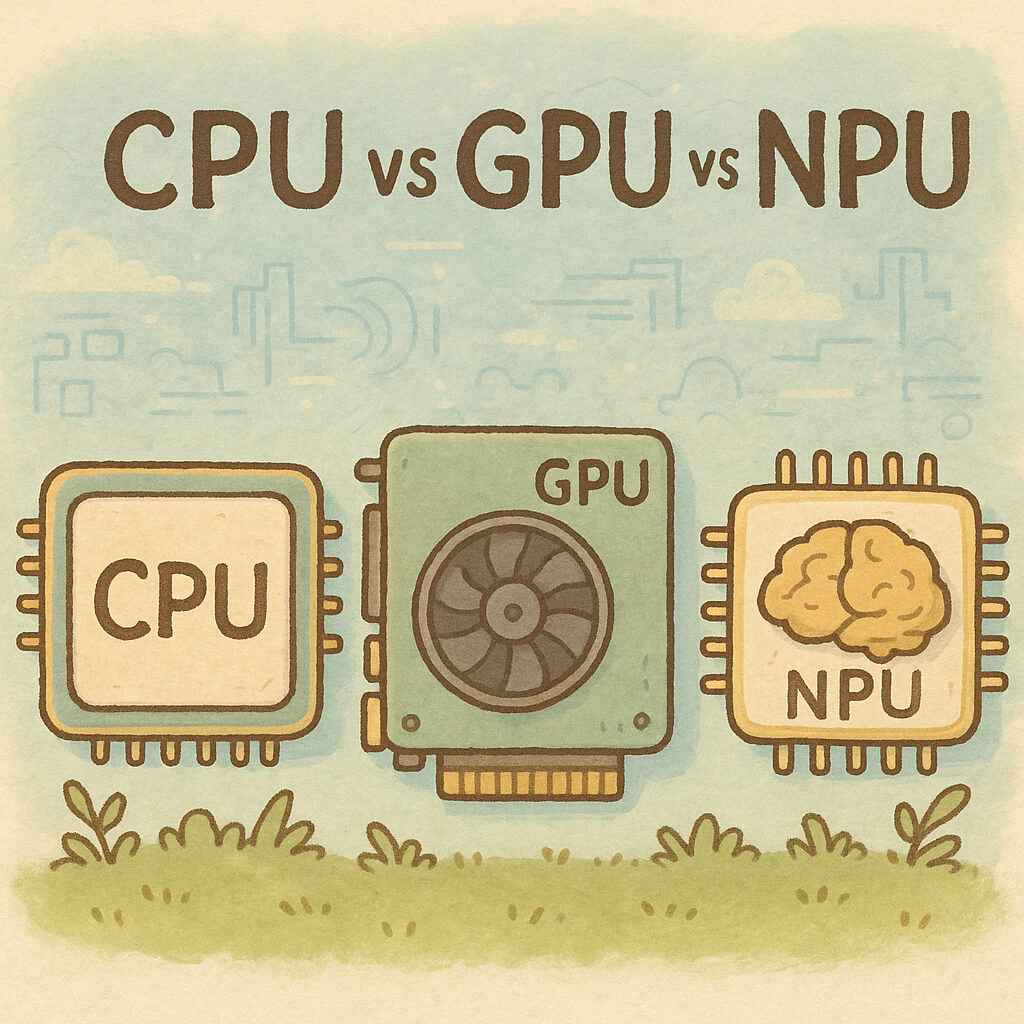
🔍 CPU · GPU · NPU — Technical but Clear Guide
This article explains the technical differences between CPUs, GPUs, and NPUs, why NPUs require high-bandwidth memory such as HBM4, and why Samsung, Nvidia, and Tesla are strategically working together.
🧠 1. CPU, GPU, and NPU Differences
📌 CPU — Flexible General Processor
The CPU handles diverse tasks using:
- branch prediction
- large multi-level caches
- out-of-order execution
- strong single-thread performance
But it struggles with extremely large parallel workloads.
📌 GPU — Parallel Compute Engine
GPUs use thousands of lightweight cores arranged in SIMD/SIMT structures. Strengths:
- matrix multiplications
- parallel AI operations
- Tensor Core acceleration
📌 NPU — Dedicated Neural Engine
NPUs adopt dataflow architecture to minimize data movement:
- MAC/systolic arrays
- INT8 / FP8 / BF16 low-precision ops
- on-chip SRAM for data reuse
⚡ 2. Why NPUs Need HBM4
📌 AI Models Require TB/s Bandwidth
LLMs such as GPT and Llama contain billions of parameters. Compute power isn't the limit — memory bandwidth is.
📌 HBM4 = 2048-bit Interface + Stacked TSV DRAM
HBM4 delivers:
- double-width 2048bit interface
- TSV-connected 3D DRAM stacks
- TB/s-class bandwidth
- lower latency and higher efficiency
📌 Without HBM4, NPUs Stall
Even 1000+ TOPS NPUs become idle without fast memory supply. HBM4 removes this “memory wall.”
🤝 3. Why Samsung & Nvidia Are Collaborating
① HBM sourcing for AI GPUs
Nvidia needs huge volumes of HBM3E/HBM4. Samsung is a key supplier.
② Advanced packaging (I-Cube / X-Cube)
HBM must sit next to GPU dies. Samsung's packaging tech makes this possible.
③ Supply chain diversification
Nvidia reduces dependency on a single supplier for long-term stability.
🚗 4. Why Tesla Works With Samsung
① Dojo supercomputer requirements
Dojo tiles depend on HBM + 2.5D packaging — Samsung can supply both.
② FSD camera & SoC collaboration
Samsung ISOCELL Auto sensors match Tesla’s high-reliability needs.
③ Cost and yield optimization
Samsung Foundry helps Tesla reduce manufacturing cost and risk.
🔍 CPU · GPU · NPU — 모바일에서도 쉽게 읽는 기술 가이드
CPU·GPU·NPU의 구조 차이, NPU가 HBM4를 필요로 하는 이유, 삼성·엔비디아·테슬라의 협업 이유를 기술적으로 그러나 이해하기 쉽게 정리했습니다.
🧠 1. CPU, GPU, NPU의 구조적 차이
📌 CPU — 범용 프로세서
CPU는 다양한 작업을 처리하도록 설계되었습니다.
- 깊은 캐시 구조(L1~L3)
- 분기 예측
- Out-of-order 실행
- 높은 단일 스레드 성능
하지만 대규모 병렬 작업은 GPU·NPU가 더 효율적입니다.
📌 GPU — 대규모 병렬 엔진
GPU는 수천 개의 ALU가 동시에 연산하는 구조입니다. 딥러닝·그래픽·행렬 연산에 매우 강력합니다.
📌 NPU — AI 전용 구조
NPU는 데이터 이동을 최소화하고 연산 밀도를 극대화하는 데이터플로우 아키텍처를 채택합니다.
- MAC / 시스토릭 어레이
- 저정밀 AI 연산 지원
- 온칩 SRAM 중심 구조
⚡ 2. NPU가 HBM4를 필요로 하는 이유
📌 메모리 대역폭이 병목
대규모 AI 모델은 초당 TB급 데이터 이동이 필요합니다. 연산 유닛보다 메모리 속도가 AI 속도를 결정합니다.
📌 HBM4의 강점
- 2048bit 초광대역 인터페이스
- TSV 기반 3D DRAM
- 낮은 지연시간
- TB/s급 대역폭
HBM4는 AI 칩의 병목을 제거하는 핵심 기술입니다.
🤝 3. 삼성 × 엔비디아 협업 이유
① HBM 대량 공급 필요
엔비디아는 HBM3E/HBM4 물량이 급증하고 있어 삼성의 참여가 필수입니다.
② 첨단 패키징 기술력
삼성의 I-Cube/X-Cube는 HBM과 AI GPU를 한 패키지에 통합할 수 있습니다.
③ 공급망 다변화 전략
엔비디아는 특정 메모리 업체에만 의존할 수 없습니다.
🚗 4. 테슬라 × 삼성 협업 이유
① DOJO AI 칩 구조
도조 타일은 HBM 메모리와 2.5D 패키징이 필수입니다. 삼성은 이를 공급할 수 있습니다.
② 자율주행 센서 & AI SoC
삼성 ISOCELL Auto는 테슬라 FSD 카메라에 적합합니다.
③ 비용 절감 + 생산 안정성
삼성 파운드리를 사용하면 생산 비용을 낮추고 TSMC 의존도를 줄일 수 있습니다.
📌 요약
- CPU = 범용 / GPU = 병렬 / NPU = AI 전용
- HBM4 = NPU 성능을 결정하는 고대역폭 메모리
- 삼성×엔비디아 = HBM + 패키징 + 공급망 전략
- 삼성×테슬라 = DOJO·FSD 핵심 협업 구조
#CPU #GPU #NPU #HBM4 #삼성엔비디아 #삼성테슬라 #AI반도체 #자율주행칩 #도조 #HBM #반도체기술 #모바일최적화