2025. 10. 28. 15:41ㆍTECH
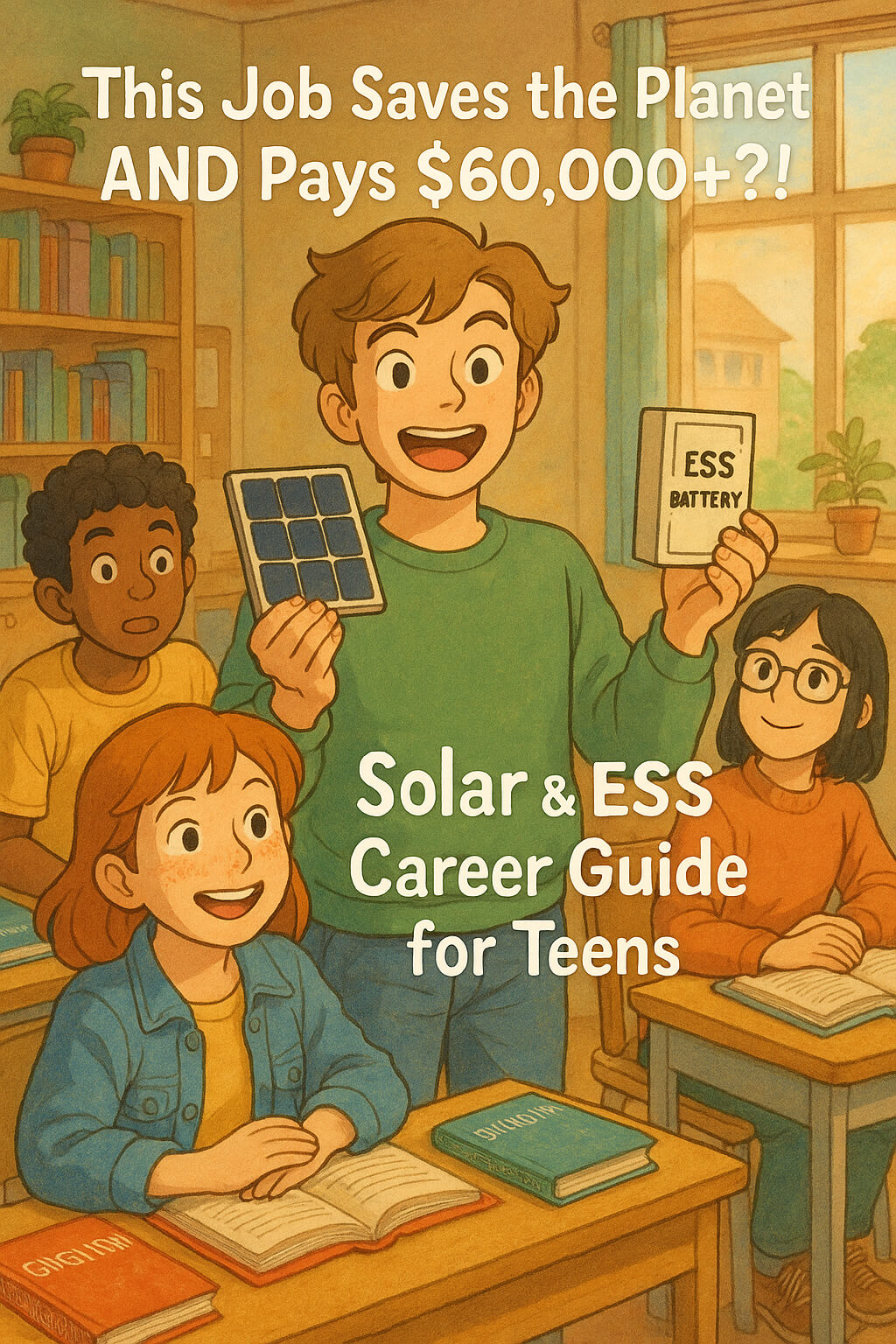
☀️ Solar Power & ESS Careers for Teenagers
— Your Guide to Future Green Jobs
If you’re a middle school or high school student and you care about the future of Earth 🌍, this is for you. Solar power (electricity from sunlight) and ESS (Energy Storage Systems, big batteries that store electricity) are two of the most important clean energy technologies in the world right now.
This guide explains:
- 🌞 What solar and ESS jobs actually do (in real life, not just in textbooks)
- 🔋 What qualifications / licenses are useful
- 💼 Where you can work (company job vs. freelance / self-employed)
- ⏰ Typical working hours
- 💸 Salary range (so you understand if this is a stable job)
- 🎓 Do you really need university, or can you just get certified and work?
- 📚 How long it usually takes to prepare for each certification
1. Why Solar Power and ESS Are Growing So Fast
- 🌏 Climate change and air pollution are global problems. Solar and batteries help reduce fossil fuel use.
- 🏛️ Many governments are investing in large solar plants and big battery farms. That means more jobs every year.
- ⚡ Cities, schools, factories, and even shopping malls are installing rooftop solar panels + battery systems to cut their electricity bill.
- 📈 More countries are promising “carbon neutral by 2050,” which means the clean energy industry needs millions of trained workers, not just scientists.
Important: This is not only a “scientist job.” There are hands-on jobs (installing panels), technical jobs (monitoring big batteries), and planning jobs (designing whole power systems for buildings). Different personalities can all fit in.
2. The Main Jobs in Solar & ESS (What You Actually Do)
🔧 1) Solar Installation Technician Hands-on / Field Work
You go to houses, schools, factories, or solar farms and physically install solar panels. You connect them safely, check that electricity flows correctly, and sometimes connect them to an ESS (battery).
- Where you work: Solar installation companies, renewable energy contractors, construction firms.
- Can you be freelance later? Yes. After a few years of experience, many technicians start their own small business doing installation and maintenance.
- Daily schedule: Often daytime, on-site, sometimes outdoors in sun/heat. Some companies work 5 days a week, some 6.
- Skills needed: Using tools, reading basic electrical diagrams, working safely on roofs / metal frames.
- Why it’s cool: You can literally point to a building and say, “I made that building run on sunlight.”
💰 Typical annual income (starting): about USD $25,000–$35,000 in many countries. 💰 With experience / team leader / self-employed: $40,000–$60,000+ possible.
🔋 2) ESS Maintenance / Battery Systems Operator Tech + Monitoring
ESS = “Energy Storage System.” Imagine massive high-performance batteries that store cheap electricity (for example daytime solar energy) and release it later (like at night, or during high demand). Your job is to keep the system safe, working, and efficient.
- Where you work: Renewable energy companies, battery manufacturers, smart-building energy teams, utility-scale battery farms.
- What you actually do: Check battery health, run diagnostics, replace faulty modules, monitor temperature, prevent fire risks, update firmware.
- Daily schedule: Often regular office hours + emergency calls if alarms go off. Less rooftop work, more monitoring screens and system checks.
- Why it’s cool: You’re basically the “battery health doctor” for a power plant.
💰 Typical annual income (early stage): around USD $30,000–$40,000. 💰 With strong experience: $50,000+ and up, especially in large industrial sites.
💼 3) Renewable Energy Project Planner / Consultant Planning / Business
This role is about designing and planning whole solar + ESS projects. Example: A logistics warehouse wants to cut its electricity bill. You calculate how many panels they need, where they should go, what battery size is ideal, and how fast the project pays for itself.
- Where you work: Energy consulting firms, engineering companies, big construction groups, green-tech startups, government energy programs.
- Daily schedule: Mostly office / meeting / site visits. A lot of proposals, spreadsheets, cost analysis, energy modeling. Less “climbing a roof,” more “talking to decision makers.”
- Why it’s cool: You influence millions of dollars of clean energy investment. You help cities get cleaner.
💰 Typical annual income (entry level analyst): ~$35,000–$45,000. 💰 Experienced consultant / project developer: $60,000–$90,000+.
3. Do I Need University for These Jobs?
Short answer: sometimes yes, sometimes no.
Path A: “I want to start working young.”
- You can start with technical certifications / licenses after high school (or sometimes even during technical high school).
- This is enough to enter jobs like Solar Installation Technician or ESS Maintenance Tech.
- After a few years of experience, you can lead teams, supervise new workers, or start your own small service business.
Path B: “I want higher responsibility and higher pay later.”
- Many project planning, system design, and engineering leadership roles prefer (or require) a university degree in areas like Electrical Engineering, Energy Systems Engineering, Mechanical Engineering (Energy Focus), or Environmental Engineering.
- With a university degree, you can qualify for jobs like Renewable Energy Project Planner / Consultant, System Designer, or Energy Strategy Manager.
- These roles often involve budgeting, safety approval, and contracts — you become “the responsible engineer.”
4. The Most Useful Certifications (Licenses)
Names vary by country, but the ideas are similar worldwide. Below are 4 common types and what they mean for your future.
1) Basic Electrical Technician License 🔌 Entry Level
- What it proves: You can safely install and maintain basic electrical systems, follow safety rules, and handle tools correctly.
- Why it matters: Solar panels are useless without safe wiring. This license shows you understand electricity, not just “how to tighten screws.”
- Prep time: ~2–3 months of steady study/practice is common for beginners.
- Study focus: safety, wiring diagrams, how to connect panels to inverters (inverters turn DC from the sun into AC for buildings).
- Job unlock: Solar Installation Tech, junior maintenance staff for buildings with solar roofs, assistant on ESS sites.
2) Solar / Renewable Energy System Installer Certification ☀️ Solar Specialist
- What it proves: You understand solar panel layout, sunlight angle, shading problems, panel capacity (kW), and how to size a battery (kWh).
- Prep time: ~4–6 months for most learners.
- Study focus: How many panels are needed for a house or factory? How much energy do they make per day? How do you mount them safely on a roof or metal frame?
- Job unlock: Solar field technician, solar site manager, performance monitoring staff (checking daily power output).
- Why companies love this: You can walk onto a site and be useful on Day 1.
3) Electrical Engineer / Energy Systems Engineer License 🏗 Advanced / Professional
- What it proves: You can calculate system load, design safe electrical systems for buildings, and approve official plans.
- Prep time: ~6–9 months of serious study (math, physics, power systems). Most people study during or after university.
- Job unlock: Project planner, system designer, grid connection approval, quality/safety supervisor.
- Income level: Often higher because you carry legal/technical responsibility.
4) High-Level Technical Expert / Senior Engineer License 🧠 Expert
- What it proves: You’re not just installing systems — you’re leading them. You can design huge systems, audit safety, and consult for governments or large companies.
- Prep time: Often 1+ year plus real-world work experience.
- Job unlock: Senior consultant, project director, technical auditor, independent expert / high-level freelancer.
- Why it matters: At this level, companies pay you not only to “do work,” but to “be responsible” for safety and performance.
5. Which Path Fits You Best?
🛠 “I like tools and action.”
You might love Solar Installation Technician or ESS Maintenance Tech. You can start young, earn money early, and maybe even run your own crew or small company one day.
📊 “I like planning, numbers, leadership.”
You might aim for Energy Project Planner / Consultant. That usually means university + certifications, then taking responsibility for big clean energy projects.
🌍 “I want to help the planet in a real way.”
All of these jobs directly reduce fossil fuel use. You’re not just posting “save the Earth” online — you’re literally wiring sunlight into real buildings.
6. Final Message for You 🌟
You don’t have to “wait until you’re an adult” to start. You can:
- Join or start a school eco/energy club.
- Build a mini solar charger for your phone as a science project.
- Study basic circuits on YouTube or with beginner kits.
- Visit a solar installation near your city and just look at how panels are mounted.
The renewable energy world needs builders, problem-solvers, planners, and leaders. You can be any of those. Maybe more than one.
- How long to study for each certification
- Recommended books and online classes
- Practice question styles and exam tips
- Step-by-step roadmap from high school to first paid job
☀️ 태양광 & ESS 진로 가이드
— 전 세계 청소년을 위한 미래 직업 안내
이 글은 중학생·고등학생을 위한 “진짜 가능한 미래 직업 가이드”입니다. 태양광 발전(햇빛으로 전기 만들기)과 ESS(에너지 저장 시스템 = 큰 배터리)는 기후위기 시대에 꼭 필요한 기술이에요. “깨끗한 전기”를 만드는 일은 이제 멋있는 이상이 아니라 돈이 되는 실제 직업입니다.
여기서는 이런 내용을 쉽게 설명합니다:
- 🌞 어떤 일을 하게 되는지 (현장에서 무슨 일을 하는지)
- 🔋 어떤 자격증(라이선스)이 필요한지
- 💼 어디에서 일할 수 있는지 (회사 취업 / 프리랜서 / 자영업)
- ⏰ 하루 근무 방식은 어떤지
- 💸 연봉(연간 수입)은 어느 정도인지
- 🎓 대학교 졸업장이 꼭 필요한지, 아니면 자격증만으로도 가능한지
- 📚 자격증 준비 기간, 공부 팁, 추천 공부 방법
1. 태양광 & ESS가 왜 이렇게 중요한가요?
- 🌏 지구 온난화, 미세먼지, 석탄·석유 의존 같은 문제를 줄이려면 깨끗한 전기가 필요합니다.
- 🏛️ 많은 나라 정부가 “신재생에너지 투자”에 돈을 쓰고 있어요. 즉, 예산이 들어간다는 건 = 일자리가 생긴다는 뜻이에요.
- ⚡ 학교, 병원, 공장, 마트, 물류센터까지 태양광과 ESS를 설치하고 있어요. 이걸 관리할 사람이 필요합니다.
- 📈 “탄소중립 2050” 같은 목표 때문에 청정에너지 산업은 앞으로 수십 년 동안 꾸준히 성장할 가능성이 커요.
중요 포인트: 이 분야는 “연구소에서 실험하는 과학자들만의 세계”가 아니에요. 현장(설치·점검), 기술(모니터링), 기획(사업제안) 등 다양한 스타일의 일이 있어요. 성격 따라 고를 수 있어요.
2. 태양광 & ESS 분야의 대표 직업
🔧 1) 태양광 설치 기술자 현장 중심
건물 지붕, 공장, 농지, 태양광 발전소 등에 실제로 태양광 패널을 설치하고 전선/인버터를 연결하는 사람입니다. 가끔 ESS(배터리)까지 같이 연결해요.
- 어디서 일하나요? 태양광 시공 회사, 신재생에너지 업체, 건설 현장 관리 회사 등
- 나중에 개인사업 가능? 가능해요. 일정 경험이 쌓이면 유지보수(고장 수리)와 소규모 설치를 개인 사업 형태로 운영하는 경우도 많습니다.
- 근무 형태: 야외 작업 많음. 어떤 회사는 주5일, 어떤 곳은 주6일. 바쁜 계절에는 집중 근무.
- 필요한 능력: 공구 사용, 안전하게 작업하기, 전선 연결 원리 이해
- 왜 매력적? “내가 설치한 패널이 지금 전기를 만들고 있다”라는 성취를 바로 볼 수 있어요.
💰 예상 연간 수입(초기): 약 3천만 원 수준(국가/지역에 따라 다름). 💰 경험 + 관리 책임자 되면: 4천만 원~6천만 원 이상도 충분히 가능.
🔋 2) ESS 유지보수 / 배터리 시스템 운영자 기술 모니터링형
ESS는 큰 배터리 창고라고 생각하면 돼요. 낮에 남는 전기를 저장했다가 밤에 꺼내 쓰게 해요. 여기서 하는 일은 “배터리가 안전하고 건강한지”를 항상 확인하는 거예요.
- 어디서 일하나요? 에너지 저장장치(배터리) 회사, 신재생 발전소 운영팀, 스마트빌딩 에너지관리팀 등
- 무슨 일을 하나요? 배터리 온도 체크, 이상 알람 대응, 고장난 모듈 교체, 화재 예방 안전 점검, 소프트웨어 모니터링
- 근무 형태: 주로 실내 / 장비실 / 관리센터 근무. 평일 주간 근무 + 긴급 호출 가능.
- 왜 매력적? 전기·배터리·안전이라는 “핵심 기술”을 직접 다룹니다. 하이테크 느낌이 강해요.
💰 예상 연간 수입(초기): 약 3천만~4천만 원 수준. 💰 숙련자(경력): 5천만 원 이상도 가능.
💼 3) 신재생에너지 사업 기획자 / 컨설턴트 사무·기획형
예를 들어 어떤 물류센터가 “전기요금을 줄이고 싶다”고 하면, “태양광 패널 몇 장 필요해요, ESS는 어느 정도 용량이면 돼요, 투자비는 얼마고 언제 회수돼요”를 설계하고 제안하는 역할입니다.
- 어디서 일하나요? 에너지 컨설팅 회사, 대형 건설/엔지니어링 회사, 정부 지원 프로젝트, 친환경 스타트업
- 근무 형태: 대부분 주5일 사무/회의 위주, 가끔 현장 방문
- 필요 능력: 숫자 계산, 보고서 작성, 설득력 있는 프레젠테이션, 정책 이해
- 왜 매력적? 한 번에 “공장 하나, 학교 하나” 같은 큰 단위의 에너지 변화를 이끌 수 있어요. 임팩트가 큽니다.
💰 예상 연간 수입: 초급(분석가급) 3천만~4천만 원대부터. 💰 경험 많은 컨설턴트/PM: 6천만~9천만 원 이상도 가능.
3. 대학교가 꼭 필요한가요?
답은 “어떤 역할을 하고 싶은지”에 따라 달라요.
경로 A: “나는 빨리 현장에서 일하고 싶어요.”
- 전문 자격증(라이선스)을 취득해서 바로 취업하는 길이 가능해요.
- 이 경우 목표 직업은 보통 태양광 설치 기술자, ESS 유지보수 기사 같이 현장/장비 중심입니다.
- 몇 년 경험을 쌓으면 팀 리더가 되거나, 소규모 유지보수/설치 회사를 차릴 수도 있어요.
경로 B: “나는 나중에 책임자/설계 담당이 되고 싶어요.”
- 전기공학, 에너지시스템공학, 기계공학(에너지계열), 환경공학 등의 대학 전공이 유리합니다.
- 이 경로는 태양광 발전소 전체 설계, 대기업/공공 프로젝트 관리, 예산/안전 승인 같은 ‘책임 있는 자리’로 이어져요.
- 연봉도 비교적 높고, “내가 승인해야 공사가 시작된다” 같은 권한이 생깁니다.
4. 현장에서 많이 쓰이는 자격증(라이선스)
나라마다 자격증 이름은 조금씩 달라도, 의미는 비슷합니다. 아래는 가장 대표적인 4가지 단계예요.
1) 전기기능사급 / 전기 기본 기술 자격 입문
- 인증 내용: 전기 배선, 안전 규칙, 간단한 회로 연결을 제대로 할 수 있는가?
- 준비 기간: 보통 2~3개월 집중 공부/실습
- 시험 핵심: 안전, 접지(감전 방지), 전선 색 구분, 도면(회로도) 읽기
- 취업: 태양광 설치팀 보조, 건물 전기 유지보수, ESS 설치 지원 등
2) 태양광 / 신재생에너지 설비 설치 자격 태양전지 전문
- 인증 내용: 태양광 패널 각도, 발전량 계산, 그늘(그림자) 문제, 패널 고정 구조, 인버터 연결 등
- 준비 기간: 약 4~6개월
- 시험 핵심: “이 건물에 패널을 몇 장 설치하면 하루에 전기를 얼마나 만들까?” “배터리는 몇 kWh가 필요할까?” 같은 실제 계산 문제가 자주 나와요.
- 취업: 태양광 시공기사, 발전량 모니터링 담당, 유지보수 현장 책임자
3) 전기기사 / 에너지시스템 엔지니어급 자격 중고급
- 인증 내용: 발전소나 큰 건물 전체 전기 시스템을 설계/검토할 수 있는가?
- 준비 기간: 약 6~9개월 (수학·물리 포함, 난이도 높음)
- 시험 핵심: 부하 계산(얼마나 많은 전기가 필요한가), 효율, 손실, 안전 규정, 정전 위험 관리
- 취업: 대기업 에너지팀, 공공기관(전력·환경 관련), 신재생에너지 프로젝트 설계/감리
- 특징: 책임이 큰 만큼 급여도 높은 편이며 “결재권”이 생길 수 있어요.
4) 고급 기술사 / 시니어 엔지니어급 자격 최상위
- 인증 내용: 대규모 태양광/ESS 프로젝트 전체를 책임질 수 있는가? 안전, 효율, 비용까지 모두 설명할 수 있는가?
- 준비 기간: 최소 1년 이상 + 실제 현장 경력 필요
- 업무: 대규모 설비 설계 승인, 사고 예방 컨설팅, 정부 또는 기업 대상 기술 자문
- 수입: 매우 높음. “전문가 한 명”으로 독립 컨설턴트(프리랜서)로도 활동 가능
5. 나는 어떤 길이 잘 맞을까?
🛠 나는 손으로 만드는 걸 좋아해요.
→ 태양광 설치 기술자, ESS 유지보수 기술자 코스 추천. 고졸+자격증으로도 충분히 시작 가능. 경험이 곧 자산이 됩니다.
📊 나는 계획·분석·설득이 좋아요.
→ 신재생에너지 사업 기획 / 컨설턴트 코스 추천. 대학교 전공 + 자격증으로 “프로젝트 책임자”쪽으로 갈 수 있어요.
🌍 나는 지구를 진짜로 바꾸고 싶어요.
→ 둘 다 가능. 설치도, 관리도, 기획도 모두 환경에 직접적인 영향을 줍니다. “말로만 환경운동”이 아니라 “전기를 바꿔버리는 실천”이에요.
6. 마지막 조언 🌟
여러분은 이미 시작할 수 있습니다. 예를 들면:
- 학교 과학 시간에 태양광 미니 발전 키트 만들어 보기
- 휴대폰 충전용 소형 태양광 패널을 직접 연결해 보는 프로젝트 해보기
- 환경 동아리(에코 클럽)에서 “학교 옥상 태양광 + 배터리 아이디어” 제안서 만들어 보기
- 유튜브나 책으로 전기 안전, 회로 기본, 배터리 관리 공부 시작하기
신재생에너지 분야는 “환경 + 기술 + 사업 감각”이 만나는 지점이에요. 여러분은 그 안에서 기술자가 될 수도 있고, 관리자가 될 수도 있고, 창업자가 될 수도 있어요.
※ 급여·근무조건은 지역·회사·경력에 따라 크게 달라질 수 있습니다. 위 수치는 이해를 돕기 위한 일반적인 예일 뿐입니다.